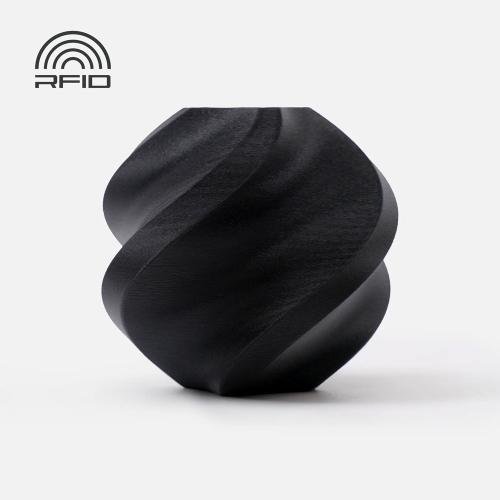
Bambu Lab Nylon
Bambu Lab Nylon is technical filament for parts that must withstand mechanical stress, heat, and wear. You use it for clamps, mounting aids, hinges, and working prototypes. Choose from variants with carbon fibers or glass fibers, such as PA6-CF, PA6-GF, and PAHT-CF. Compare the properties and check the requirements for your printer. Proper drying and keeping it dry during printing are essential.


Why is nylon so strong and wear-resistant?
Nylon is the well-known name for a group of plastics called polyamides. That is why you often see the abbreviation PA on the packaging. These materials can combine strength, toughness, and wear resistance. This makes them interesting for parts that move or are subjected to loads regularly.
Toughness means that a material can absorb energy before it breaks. Unfilled nylon can often bend slightly in this regard. Carbon fibers and glass fibers generally make nylon stiffer. This helps with parts that must deflect less under load.
Not every nylon variant has the same properties. The base raw material, fibers, and moisture content together determine the behavior. The print direction and layer adhesion also influence the strength of your part.
For simple holders or housings , Bambu Lab PETG is often sufficient. Nylon becomes interesting when heat, wear, or mechanical stress place higher demands. For a first prototype, you can also use Bambu Lab PLA .
Moisture and nylon: why drying is essential
Nylon absorbs moisture from the air. During printing, this moisture can cause bubbles, strings, and irregular material feed. Layer adhesion can also deteriorate. Therefore, dry the filament before use, even when the roll is new out of the packaging.
Use the drying settings for your exact variant. For PA6-CF, PA6-GF, and PAHT-CF, Bambu Lab typically specifies 80°C for 8 to 12 hours. These are settings for an air-circulation drying oven. The correct procedure may vary depending on the drying device.
PPA-CF has higher requirements. For this, Bambu Lab specifies 100 to 140 °C for 8 to 12 hours in a suitable drying oven. Not every filament dryer reaches this temperature. Therefore, check before purchasing whether you can dry the material properly.
- Dry before printing. Use the prescribed temperature and time for your material and device.
- Keep it dry during printing. Feed the filament from a suitable drying box or enclosed feed box.
- Store the roll sealed. Use airtight packaging with desiccant and limit exposure to moisture.
- Check the coil. It must withstand the selected drying temperature.
A desiccant box helps keep dry filament dry. Such a box does not replace active drying. Nor does a closed printer replace a drying box: both have a different function.
Moisture also affects the printed part. PA6, in particular, can become less rigid and change size after absorbing moisture. Therefore, test precision parts in the environment where you will be using them.
For which applications do you choose Bambu Lab Nylon?
Nylon is suitable for many technical projects where a part needs to do more than just maintain its shape. You use it, for example, for:
- Gears: for suitable drives and prototypes, after checking for load and wear.
- Hinge parts: parts around a hinge pin that move regularly.
- Clamps and brackets: for securing and positioning parts.
- Assembly aids: tools used to hold parts in place during assembly.
- Tool accessories: holders, adapters, and attachments for your workshop.
- Working prototypes: models used to investigate fit, movement, and load.
Select the variant based on the application. A clamp that needs to flex requires different properties than a rigid mounting bracket. For moving parts, the fit, contact surface, and any lubrication also matter.
Print a test piece first before subjecting a part to prolonged stress. Check not only the shape, but also wear and deformation during use.
What do you need to print nylon?
Bambu Lab Nylon requires more preparation than PLA or PETG. Check if your printer, build plate, and drying equipment are suitable for the chosen variant. Then use the appropriate material profile in Bambu Studio.
A suitable, closed printer
For the mentioned reinforced nylon variants, use an enclosed printer with a heated print bed. A stable temperature helps limit warping and poor layer adhesion. Also ensure good ventilation of the workspace.
For PA6-CF, PA6-GF, and PAHT-CF, Bambu Lab specifies a nozzle temperature of 260 to 290 °C. The stated bed temperature with adhesive is 80 to 100 °C. For PPA-CF, the ranges are higher: 280 to 310 °C and 100 to 120 °C.
Use the profile that matches your printer and material. Check in advance whether your device can handle the required settings. Do not simply copy the settings from one nylon variant to another.
A wear-resistant nozzle and suitable extruder
Carbon fibers and glass fibers cause extra wear on the nozzle. Use a suitable hardened steel nozzle for PA6-CF, PA6-GF, PAHT-CF, and PPA-CF. Also check whether the extruder gears are suitable for fibrous filament.
A 0.4 mm nozzle is supported for these materials. Bambu Lab generally recommends 0.6 mm to limit the risk of clogging. A 0.2 mm nozzle is not suitable.
Good bed adhesion and dry supply
Use a suitable build plate and the recommended adhesive. A brim, an extra edge around the model, can help prevent corners from coming loose. Allow the print to cool down completely before removing it.
Keep the filament dry throughout the entire print. Additionally, check the material feed: not every nylon variant is suitable for automatic feeding via an AMS.
Choosing the right Bambu Lab Nylon variant
Unfilled nylon is generally more flexible than fiber-reinforced nylon. A reinforced variant is particularly interesting when you are looking for more stiffness or shape retention. Within the Bambu Lab range, you will find various reinforced polyamides:
| Variant | Properties | When to choose? |
|---|---|---|
| PA6-CF | PA6 with carbon fibers. High strength and stiffness in dry conditions. | For rigid clamps, brackets, and technical components. Take into account changes due to moisture absorption. |
| PA6-GF | PA6 with glass fibers. Offers stiffness and less warping than unfilled PA. | For mounting aids, housings, and consumables. Also available in various colors. |
| PAHT-CF | Reinforced polyamide with lower moisture absorption than PA6-CF. | For components where more stable properties under fluctuating humidity are important. |
| PPA-CF | A specialized polyamide with carbon fibers, high stiffness, and high heat resistance. | For demanding technical applications, with suitable printer and drying equipment. |
Compare material data under the same conditions. A dry filament strength value does not tell the whole story regarding use in a humid environment. Also pay attention to the print direction in which a value was measured.
Finally, check the color and quantity of filament. Not every spool contains the same weight. When calculating your material requirements, also take supports and test prints into account.
Order Bambu Lab Nylon from Elektronica voor jou
Elektronica Voor Jou is an official Bambu Lab reseller in the Netherlands. We offer technical nylon variants for a wide range of applications. View the properties, version, and current availability for each product.
If you order a product that is in stock on a working day before 16:00, we will ship it the same day. Pickup in Leusden is also possible. Unsure about the material or your printer? Contact us for help with your choice.
Frequently asked questions about Bambu Lab Nylon
Why do I need to dry Bambu Lab Nylon before use?
Nylon absorbs moisture from the air. During printing, this can cause bubbles, strings, and poor layer adhesion. Thorough drying helps achieve even material feed. Afterward, keep the filament dry during printing as well.
Is nylon stronger than PETG?
Many reinforced nylon variants offer greater stiffness, strength, and heat resistance than standard PETG. However, this does not automatically apply to every property or application. Moisture, print direction, and design influence the result. For simple parts, PETG may be sufficient and easier to print.
Do I need a special nozzle for nylon?
For nylon with carbon or glass fibers, you need a wear-resistant nozzle, such as hardened steel. The fibers can quickly wear out a standard brass nozzle. Unfilled nylon has different requirements. Therefore, always check the specifications of your variant.
Can I use Bambu Lab Nylon for gears?
Yes, nylon can be suitable for gears. The right choice depends on rotational speed, load, temperature, and the material of the other gear. Not every fiber-reinforced variant is automatically the best choice. Test fit, wear, and heat generation before using the part for an extended period.
Is Bambu Lab Nylon suitable for beginners?
Nylon requires experience with material settings, bed adhesion, and drying. It is better to start with PLA or PETG while you are still getting to know your printer. Switch when you need the technical features and have suitable equipment.
Can I use Bambu Lab Nylon with an AMS?
That varies by variant. Bambu Lab supports PAHT-CF and PA6-GF in the original AMS. PA6-CF and PPA-CF are not compatible. Always check the combination of your filament, AMS model, and printer. Furthermore, compatible material feeding does not mean that the system can dry the filament sufficiently.