EV Chargers
Do you want to charge your electric car at home or at a charging station? Then choose a charging cable that suits your car and charging point. Pay attention to the plug, the number of phases, and the maximum charging capacity.
A Type 2 charging cable is widely used for electric cars in Europe. In our range, you will find cables for 11 and 22 kW. You can also choose from multiple cable lengths.
Don't have a charging station? With a suitable portable EV charger, you can charge a car via a grounded socket. This is often slower than charging via a charging station.
The car, charging cable, and charging station together determine the speed. The lowest value forms the limit. Therefore, a 22 kW cable does not automatically provide 22 kW of charging power.
View our EV chargers and charging cables. Before purchasing, check your car's connection and charging capacity. This way, you choose a cable that suits your electric car and charging method.


Choosing a charging cable for your electric car
A good charging cable provides the connection between your electric car and a charging point. Which cable you need depends on the connector and the charging capacity.
Also pay attention to the number of phases and the desired length. The wrong plug will not fit. A cable with a lower wattage can slow down charging.
Therefore, always check your car's manual or charging specifications. Also check the connection of the charging point.
What is a Type 2 charging cable?
Type 2 is a widely used connector for electric cars in Europe. The plug has a round shape with multiple contact points.
Many public charging stations and wallboxes have a Type 2 connector. Many electric cars and plug-in hybrids also use this connector for charging with alternating current.
Check both sides of the connection. The car's connection must match the cable's plug. The charging point must also have the correct connection.
A Type 2 charging cable is not the same as a fixed charging station. The cable only forms the connection between the car and the charging point.
One phase or three phases
An electric car can charge via one or three phases. The number of phases affects the potential charging capacity.
When charging via a single phase, the car uses one circuit. A mobile charger via a standard wall socket often operates on a single phase.
A charging station can also use three phases. This allows the car to charge faster. However, the car must support this power.
Not every electric car can charge using three phases. Some models only charge via a single phase. A three-phase charging cable might fit in such cases, but the car will not utilize its full power.
Therefore, check how many phases your car's internal charger supports.
An 11 or 22 kW charging cable
A 16 A three-phase Type 2 charging cable usually supports a maximum of 11 kW. A 32 A three-phase cable usually supports a maximum of 22 kW.
A 22 kW cable is suitable for higher power. This does not mean that every car will charge at 22 kW with it.
The actual speed depends on three components:
- The maximum power of the charging station
- The load capacity of the car
- The maximum power of the charging cable
The component with the lowest power determines the speed. Can your car charge at a maximum of 11 kW? Then the charging power remains a maximum of 11 kW, even with a 22 kW cable.
A cable with higher capacity can be useful for a future car. Always check if the cable is suitable for the charging point and vehicle.
What length do you need?
A charging cable must be long enough to easily connect the car. Therefore, check the location of the connection on the car. Also pay attention to the distance to the charging station.
A 4-meter cable is compact and easy to store. This length works well if you can park close to the charging point.
A longer cable provides more room. This is useful if the charging point is further away. You also have more freedom when parking.
A long cable is heavier, however. It also takes up more space in the car. Therefore, do not choose a length greater than you usually need.
Lay the cable down while charging so that no one trips over it. Roll up the cable neatly after use. This helps prevent damage and sharp kinks.
What is a portable EV charger?
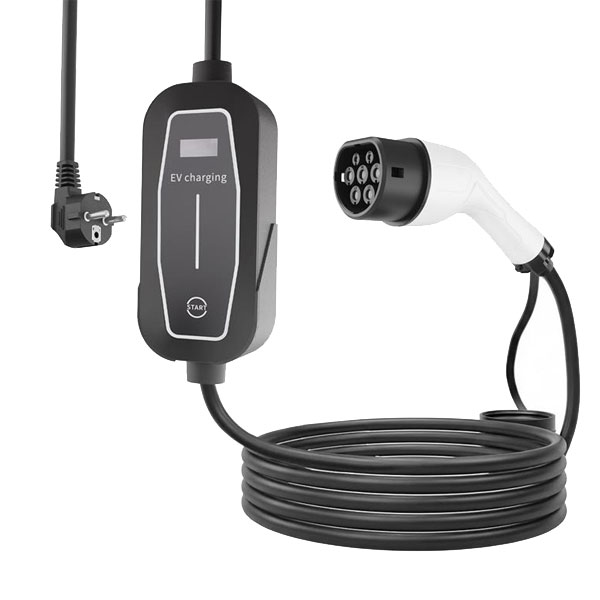
A portable EV charger makes it possible to charge an electric car via a suitable socket. The cable has a small box that regulates and monitors the charging process.
A portable charger is handy when there is no fixed charging station available. You can take it with you, for example, as an extra charging option.
Charging via a standard wall socket is often slower. The socket and the electrical installation must also be suitable for prolonged load.
Use only a grounded outlet that is in good condition. Do not use an extension cord or power strip unless the manufacturer expressly permits it. If in doubt, have the connection checked by a qualified electrician.
A fixed charging station on a suitable circuit is often a better solution for daily use.
Be careful with a charging adapter
A charging adapter establishes a connection between different types of sockets. Not every adapter is intended to charge a car.
Therefore, carefully check what the product is intended for. Look at the direction of the connection, the maximum current, and the maximum power.
A plug that fits physically is not automatically suitable for every application. Use an adapter only as described by the manufacturer.
Safe loading
Check the charging cable before each use. Do not use it if the plug, casing, or cable is damaged.
Keep the contacts clean and dry. Replace protective caps if present. Do not pull the plug out of the socket by the cable.
Avoid sharp kinks and heavy pressure on the cable. Do not drive over the cable and do not place it in a location where it is easily damaged.
Is the plug or connector getting noticeably warm? Then stop charging. Have the cable and connector checked before using them again.
Always follow the manual for the car, charging station, and charging cable.
Which EV charging cable fits your car?
First, check if your car has a Type 2 connector. Then, check how many phases and what charging capacity the car supports.
Next, choose between an 11 or 22 kW cable. Also determine what length you need. A short cable is easy to store. A longer cable provides more space when parking.
Don't have a fixed charging station? Then a mobile EV charger can be an additional option. However, do check if the socket and the installation are suitable.
By comparing the connector, power, and length, you will find a charging cable that fits your electric car.