
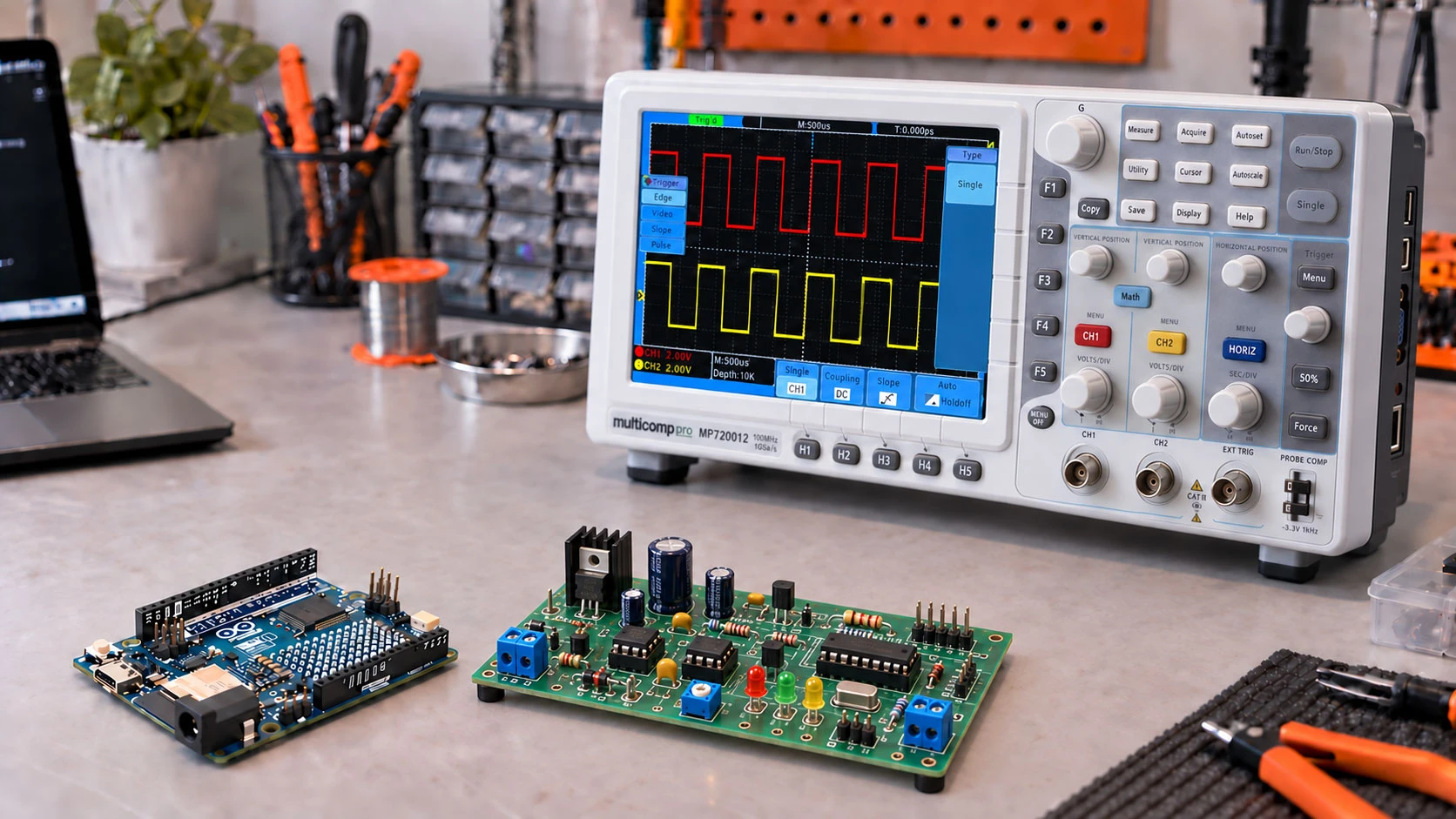
What is an oscilloscope and which one do you need?
With a multimeter, you measure how much voltage is present somewhere. But you don't see how that voltage changes. For that, you use an oscilloscope.
An oscilloscope makes electrical signals visible. You see the voltage as a line on the screen. This line is called a waveform. You can see how a signal behaves from the waveform.
This way, for example, you detect noise, distortion, and short voltage spikes. You can also compare two signals. This helps with testing and repairing electronics.
But which oscilloscope do you need? Is 40 MHz sufficient, or is it better to choose 100 or 200 MHz? And what do the sample rate, memory depth, and number of channels mean?
In this selection guide, we explain the most important features. We also help you choose a model that suits your projects.
For many hobby projects and general measurements, a two-channel digital oscilloscope is a good starting point. A bandwidth of 40 to 100 MHz is often sufficient. Are you working with faster or more complex circuits? Then you may need more bandwidth, channels, and memory.
What is an oscilloscope?
An oscilloscope is a measuring instrument for electrical signals. The screen shows how a voltage changes over time.
The vertical axis shows the voltage. The horizontal axis shows the time. This creates a graph of the measured signal.
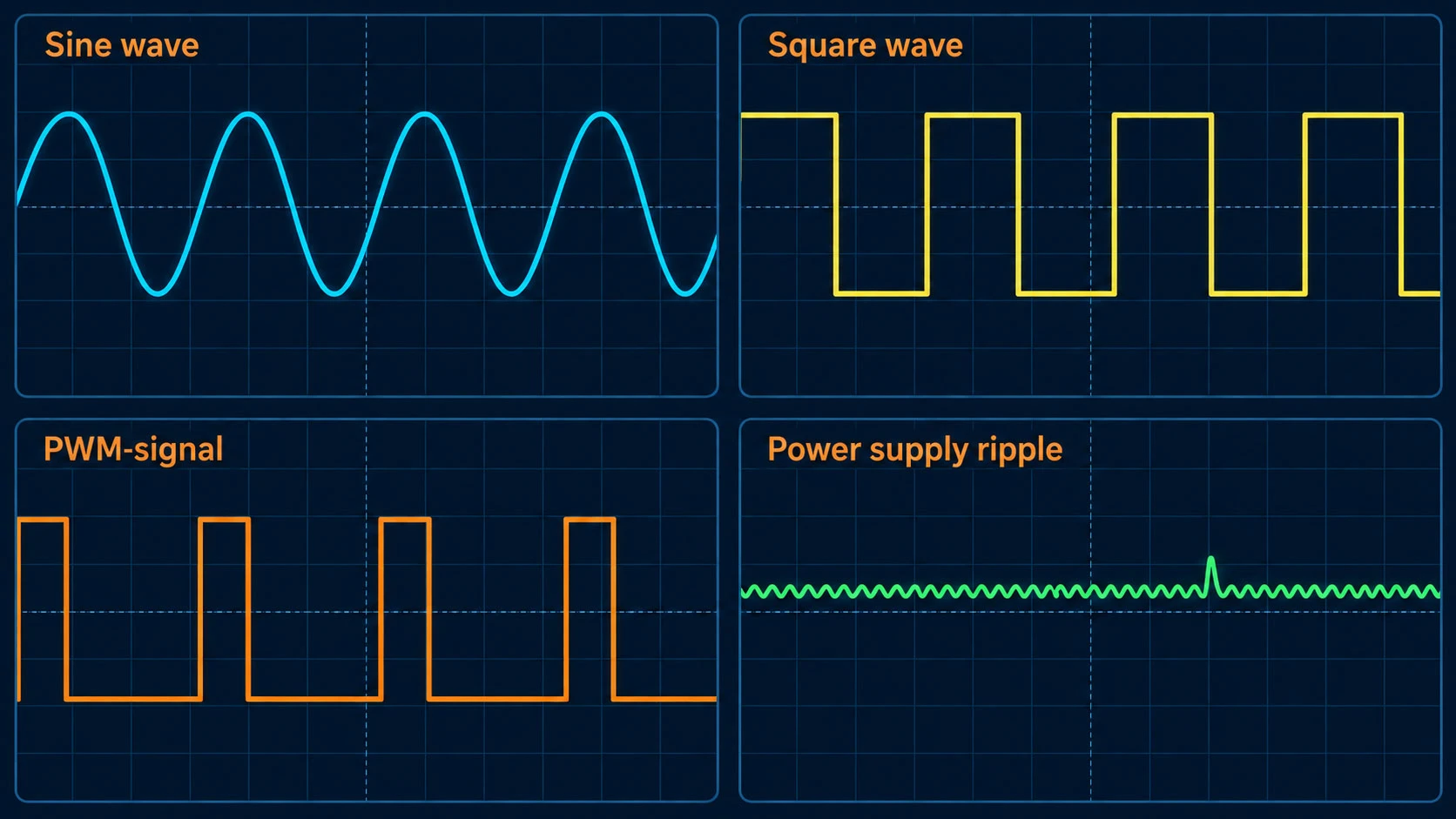
A stable direct current voltage usually appears as a straight line. An alternating current voltage can look like a sine wave. Digital signals are often recognizable as square waves.
The shape of the signal provides important information. You don't just see how many volts you measure. You also see when and how fast the voltage changes.
That is useful in the event of malfunctions. A multimeter, for example, can indicate a stable voltage of 5 volts. However, that voltage can sometimes drop briefly. An oscilloscope can make such a short voltage dip visible.
What do you use an oscilloscope for?
An oscilloscope is used in the design, testing, and repair of electronics. Both hobbyists and professional technicians work with it.
You can use an oscilloscope for, among other things:
- Checking power supplies and sensors
- Measuring frequencies and pulses
- Viewing PWM signals
- Testing Arduino, Raspberry Pi , and ESP32 projects
- Comparing two or more signals
- Finding noise and voltage spikes
- Troubleshooting a circuit
Suppose an Arduino drives a motor with a PWM signal. A multimeter usually shows an average voltage. On an oscilloscope, you see the individual pulses.
This allows you to monitor the frequency and pulse duration. You can also see what proportion of the time the signal is active. This is called the duty cycle.
An oscilloscope is also useful for testing a power supply. The output may average a steady 12 volts. Nevertheless, there can be ripple or noise on the voltage. Such small changes become visible on an oscilloscope.
What can you measure with an oscilloscope?
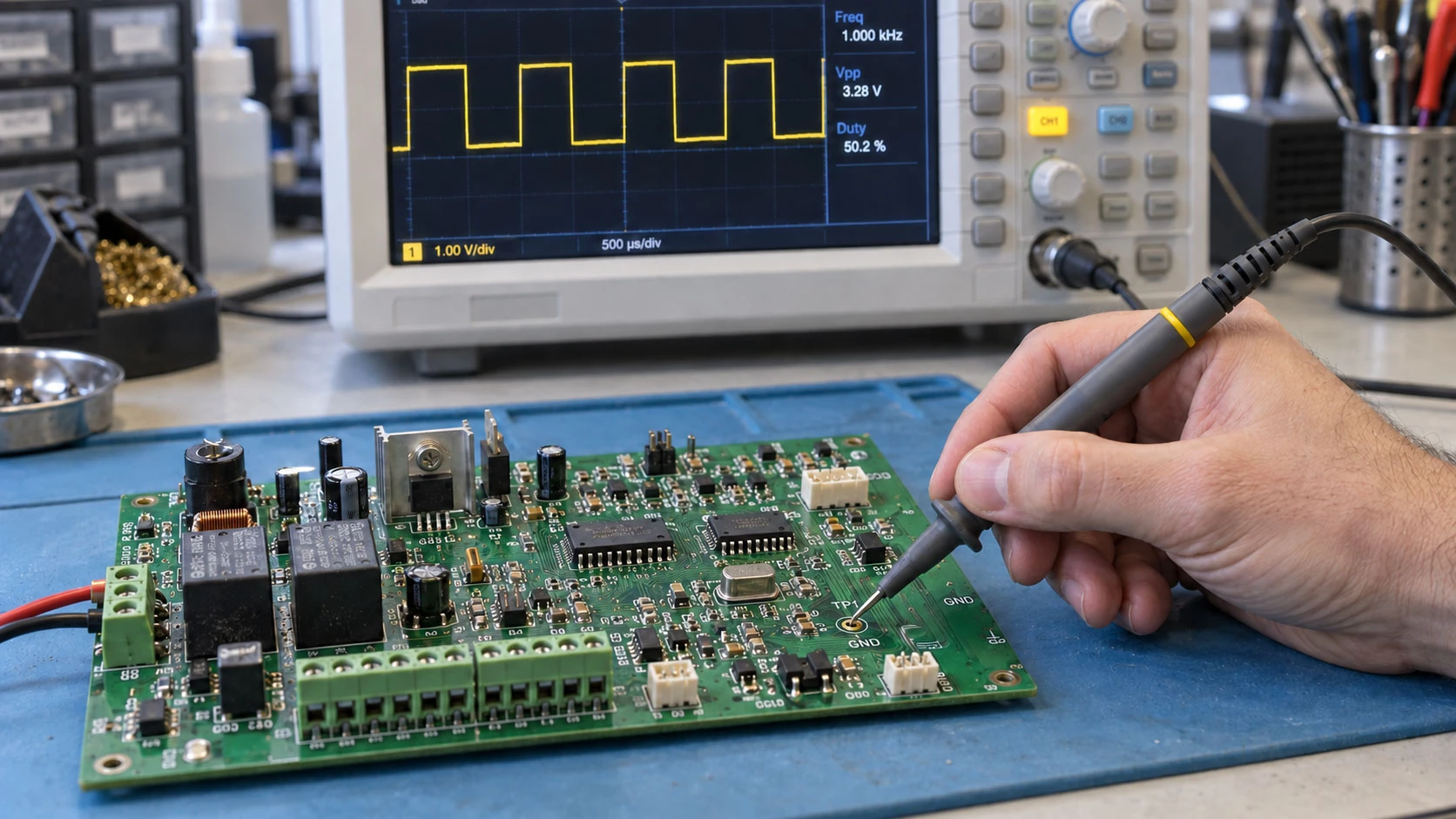
A standard oscilloscope input measures voltage. You can then read various properties from the waveform.
The height of the line indicates the magnitude of the voltage. For example, you can measure the highest and lowest voltages. You can also determine the difference between these two values. We call this the peak-to-peak voltage.
The horizontal axis provides information about time. You can see how long one complete cycle lasts. This is called the period time. From this time, the oscilloscope can calculate the frequency.
With digital signals, you can also measure the pulse width. This value indicates how long a pulse lasts. The duty cycle shows what proportion of the total period the signal is active.
The rise and fall times can also be important. After all, a digital signal does not change from low to high instantly. The transition takes a small amount of time. In high-speed electronics, that time can affect the operation of a circuit.
With multiple channels, you can view signals simultaneously. For example, you can compare an input with an output. You can also check whether two signals start at the right time.
An oscilloscope normally does not measure current. This is possible with a suitable current probe. Another option is to measure the voltage across a known resistor. When using this method, always check that the measurement setup is safe.
Oscilloscope or multimeter: what is the difference?
A multimeter and oscilloscope both measure electrical values. However, you use them for different types of measurements.
A multimeter usually displays a single number. This instrument is suitable for quick checks. You can use it to measure voltage, current, resistance, and continuity, among other things.
An oscilloscope shows how a voltage changes. You see what happens before, during, and after a measurement. This is especially important for rapidly changing signals.
The main differences are:
- A multimeter usually displays one measurement value. An oscilloscope displays a waveform.
- A multimeter is suitable for stable values. An oscilloscope is suitable for changing signals.
- A multimeter can often measure voltage, current, and resistance. An oscilloscope measures voltage at the base.
- A multimeter is useful for quick checks. An oscilloscope provides more information about the timing.
- A multimeter can miss brief disturbances. An oscilloscope can make these disturbances visible.
Suppose a power supply delivers 5 volts. The multimeter might consistently show approximately 5 volts. The oscilloscope can show that the voltage sometimes briefly drops to 4 volts.
A multimeter and an oscilloscope therefore do not replace each other. On the contrary, they complement each other. You usually need both instruments on a complete electronics workstation.
What types of oscilloscopes are there?
Most modern oscilloscopes are digital. They convert the measured signal into measurement points. You can then save and enlarge the waveform. You can also analyze the signal further.
There are different types of oscilloscopes:
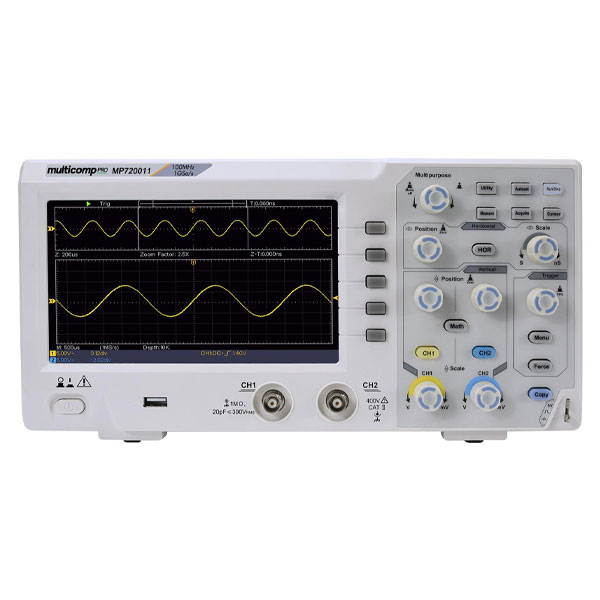
- A bench oscilloscope is intended for a fixed workstation. This type fits well in a workshop, school, or development room.
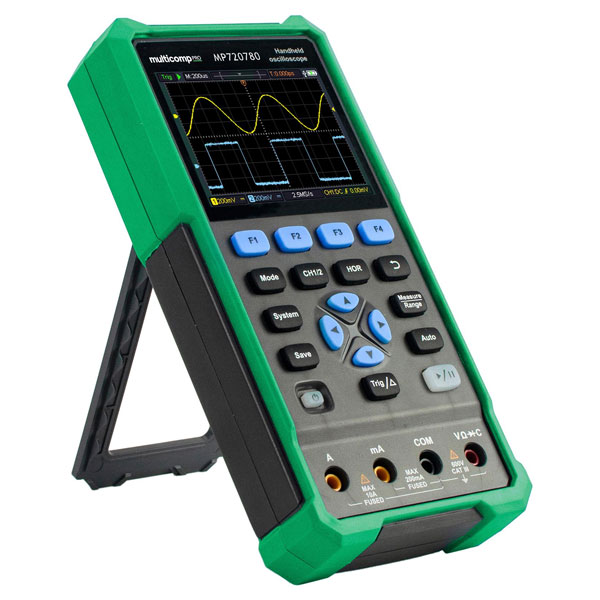
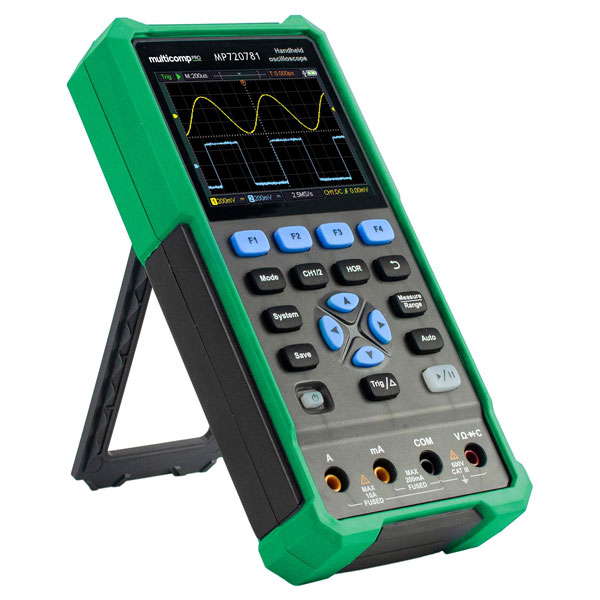
- A handheld oscilloscope is compact and portable. This type is convenient for service and measurements on location.
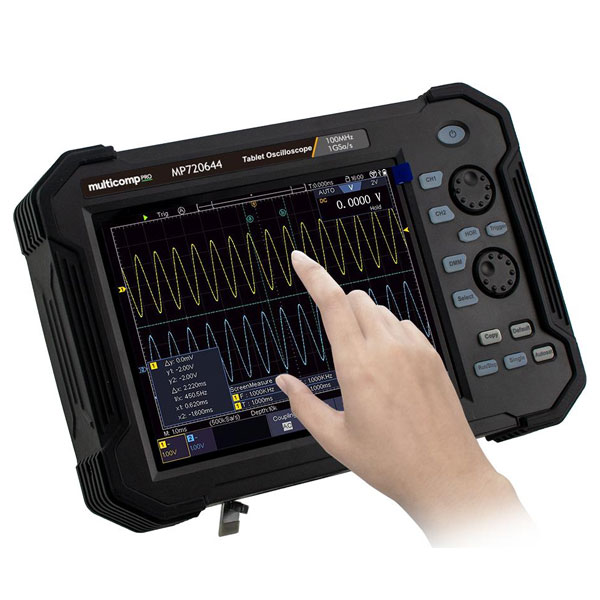
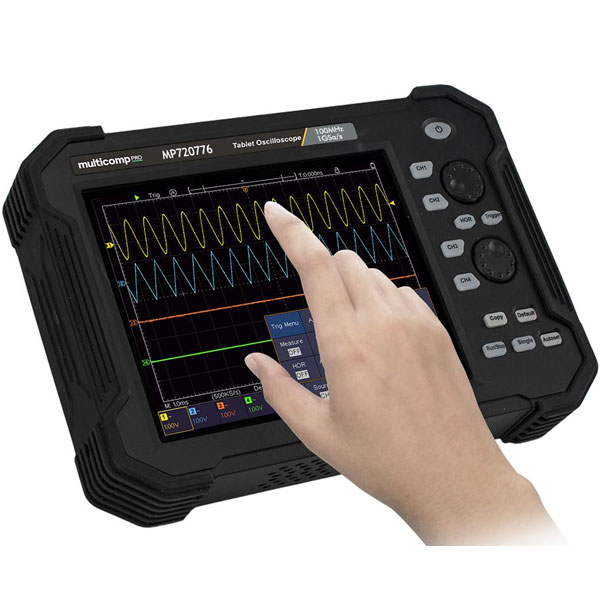
- A tablet oscilloscope has a relatively large screen. The compact housing makes it suitable for stationary and mobile use.
- A Mixed Signal Oscilloscope has analog and digital inputs. This type is particularly interesting for embedded development.
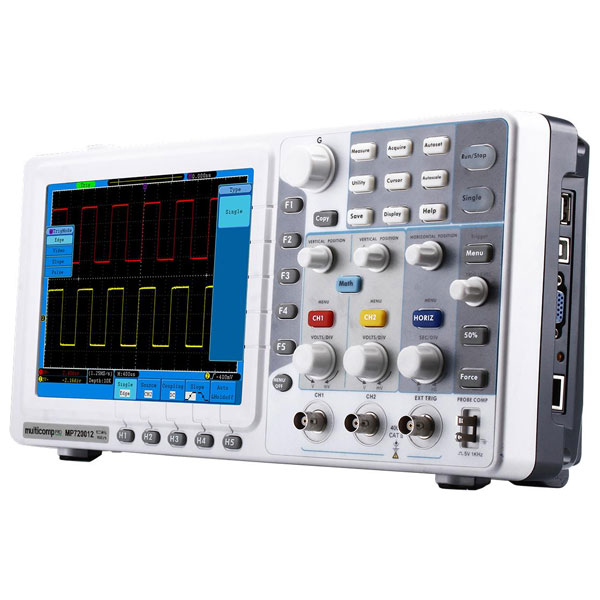
A bench oscilloscope has its own screen and clear rotary knobs. That works well if you frequently adjust settings.
A handheld oscilloscope usually runs on a battery. This makes the instrument easy to take with you. Some models also have a multimeter or signal generator.
A tablet oscilloscope offers ample screen space. This makes it easier to view multiple signals simultaneously.
A Mixed Signal Oscilloscope is often abbreviated to MSO. This type has analog channels and digital inputs. This allows you to examine different types of signals simultaneously.
Always check which functions are present by default. Digital inputs and protocol decoding may sometimes be optional.
What should you look out for when choosing?
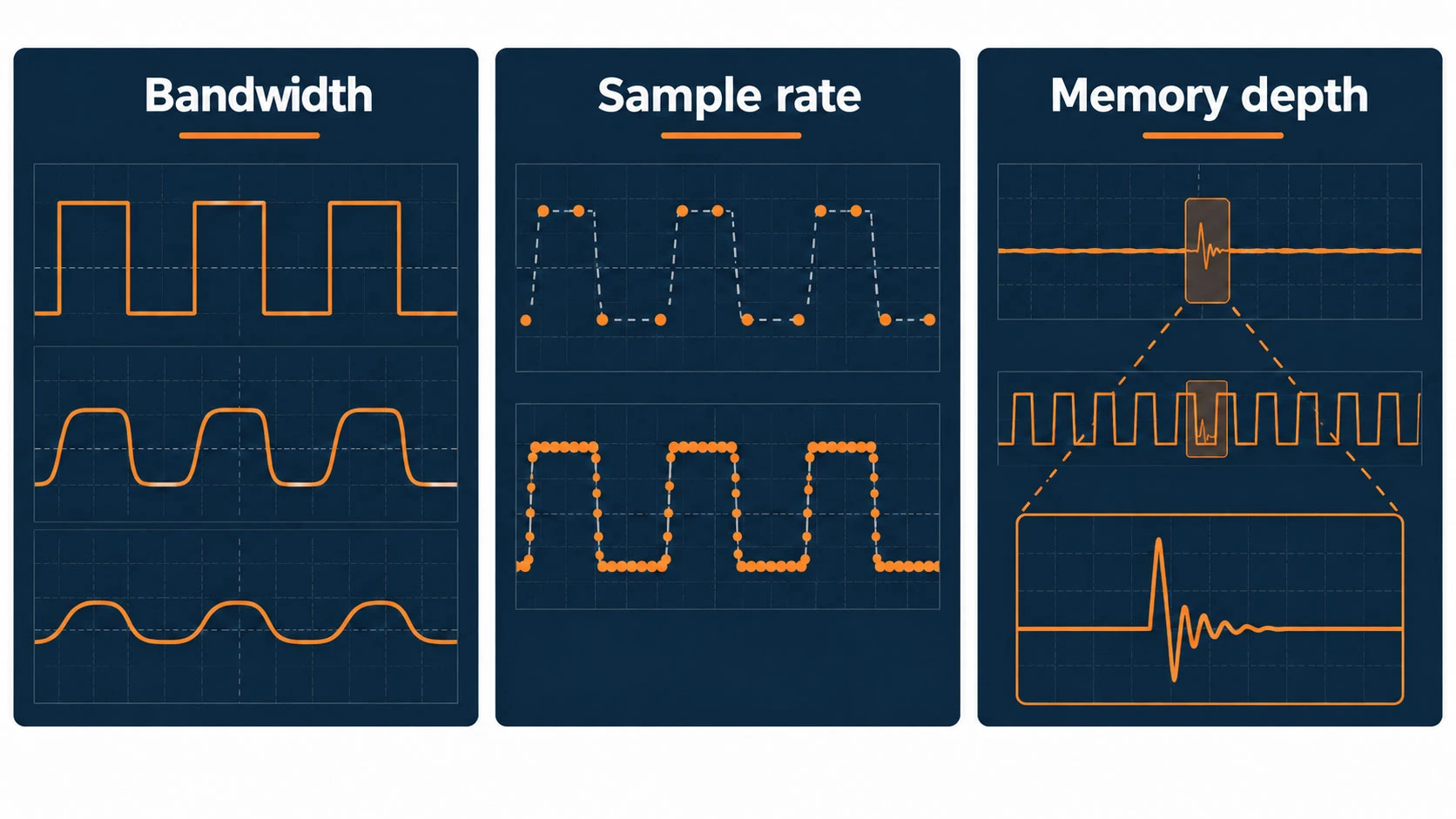
Bandwidth is an important characteristic. This value is expressed in megahertz, abbreviated as MHz. Bandwidth indicates which frequencies the oscilloscope can process.
A 100 MHz oscilloscope does not measure a signal of exactly 100 MHz completely without loss. The measured signal is already attenuated at the maximum bandwidth. Therefore, choose more bandwidth than you think you immediately need.
Digital signals require extra attention. A square wave contains more frequencies than just the fundamental frequency. Fast edges therefore require extra bandwidth.
The sample rate is also important. This value indicates how many measurement points the oscilloscope records per second. The Dutch term for this is bemonsteringssnelheid.
A sample rate of 500 MS/s represents 500 million measurement points per second. A value of 1 GS/s represents a maximum of one billion measurement points per second.
A low sample rate can give a misleading picture. The oscilloscope may then miss parts of the signal. As a result, a fast signal sometimes appears slower than it actually is. This phenomenon is called aliasing.
Also pay attention to the number of channels used. Some models achieve the maximum sample rate with only one active channel. With two or four active channels, the speed may decrease.
The memory depth determines how many measurement points the oscilloscope can store. More memory allows for longer recordings. You can then zoom in on a small part of the signal.
A small memory is often sufficient for a steady sine wave or simple square wave. A larger memory helps with longer and varying signals. Short disturbances are then also easier to find.
How much bandwidth and channels do you need?
The correct bandwidth depends on the signals you want to measure. The values below are practical guidelines. They are not hard limits.
- For audio and simple electronics, 20 to 50 MHz is often sufficient. Two channels are usually enough.
- For education and hobby use, you can choose 40 to 100 MHz. Here too, two channels are often sufficient.
- For Arduino, ESP32, and other embedded projects, 50 to 100 MHz is suitable. Choose two or four channels.
- For complex embedded projects, 100 to 200 MHz is a better starting point. Four channels then offer more possibilities.
- For fast digital electronics, 200 MHz or more may be required. Choose four or more channels if you want to view many signals simultaneously.
For simple measurements, two channels are often sufficient. This allows you to compare an input and an output. You can also view a PWM signal alongside a sensor output.
Four channels offer more possibilities. For example, you can monitor multiple power lines simultaneously. This is useful when starting up a circuit.
Additional channels are also useful in digital communication. With SPI, for example, you can view the clock, data, and chip select simultaneously.
More channels often make an oscilloscope more expensive. Therefore, determine in advance how many signals you want to measure simultaneously. Also check the sample rate when using all channels.
What other characteristics are important?
The trigger function determines when the oscilloscope starts measuring. Without a good trigger, the signal often moves across the screen. A properly set trigger ensures a stable waveform.
A simple edge trigger starts at a specific voltage level. This is sufficient for many standard measurements. More advanced oscilloscopes can also respond to a short or anomalous pulse. This helps with errors that do not occur consistently.
The vertical resolution is expressed in bits. This value determines how many voltage levels the oscilloscope can distinguish. A higher resolution helps in viewing small differences.
This is particularly interesting for analog sensors, audio signals, and power supplies, for example. However, resolution is not the only factor determining quality. Noise, settings, and the probe head used also have an influence.
A built-in signal generator can also be handy. With it, you can create a test signal yourself. You feed this signal into a circuit and then measure the response. This way, you do not always need a separate function generator.
Finally, look at the practical features. Consider the screen, controls, and connections. The ability to save screenshots and measurement data can also be important.
Which oscilloscope suits your application?
Elektronica Voor Jou sells various types of oscilloscopes. The range extends from portable models to models with four channels. The best choice depends on your work.
These are some practical guidelines:
- For basic mobile use, you can choose a handheld model. A version with two channels and 40 MHz is suitable for many general measurements.
- Do you also want to generate test signals on the go? Then choose a handheld oscilloscope with a built-in signal generator.
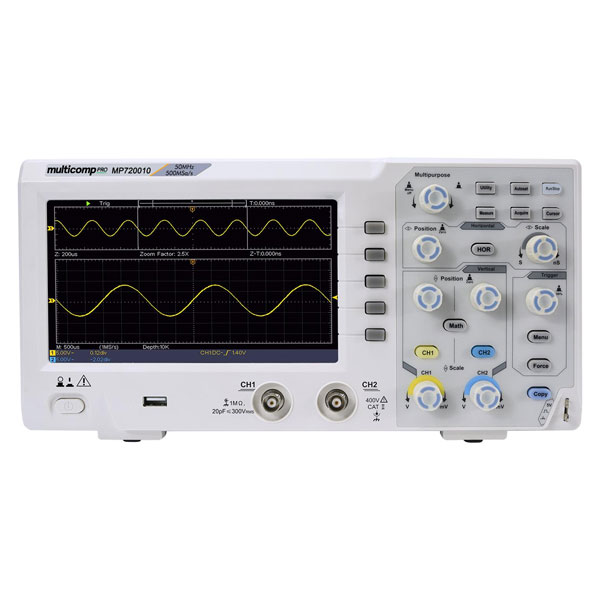
- For general workbench use, a digital oscilloscope with two channels and 50 to 100 MHz is suitable.
- Do you want to record longer signals? Then look for a high sample rate and sufficient memory.
- Do you want to monitor multiple signals simultaneously? Then choose a model with four channels.
- Are small voltage differences important? Then look at a model with a higher vertical resolution.
- High-speed electronics require more bandwidth. A model with four channels, 200 MHz, and 1 GS/s offers more measurement headroom.
For beginners, a straightforward two-channel model is usually a good choice. A bandwidth of 40 to 100 MHz is suitable for many hobby projects. Also consider the display and controls. You will use these components during every measurement.
Do you want to take the oscilloscope with you often? Then choose a handheld model. The 40 MHz handheld oscilloscope has two channels. The model is suitable for mobile use and general measurements.
Would you like to create your own test signals? Then check out the handheld oscilloscope with 70 MHz and signal generator . With this, you can generate a test signal. Afterwards, you measure how the circuit responds to that signal.
For complex projects, four channels are useful. You can then monitor more signals simultaneously. A larger memory helps in searching for short disturbances.
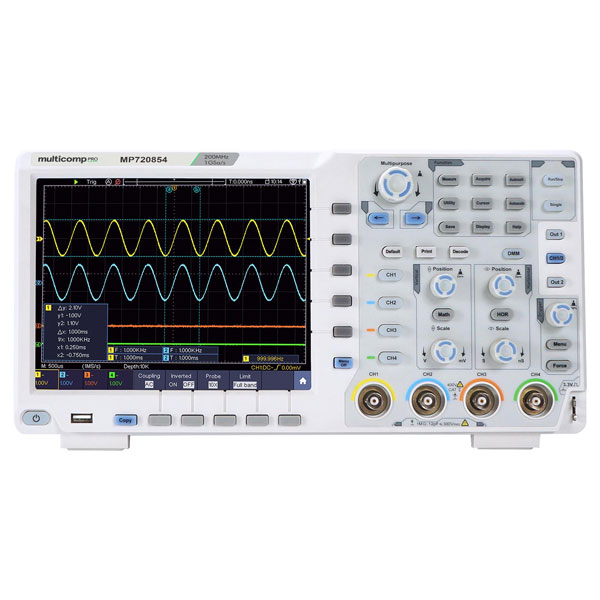
The Multicomp Pro oscilloscope with 200 MHz has four channels. The model offers a sample rate of 1 GS/s. It also has 40 Mpts of memory. This makes the model suitable for fast and extensive measurements.
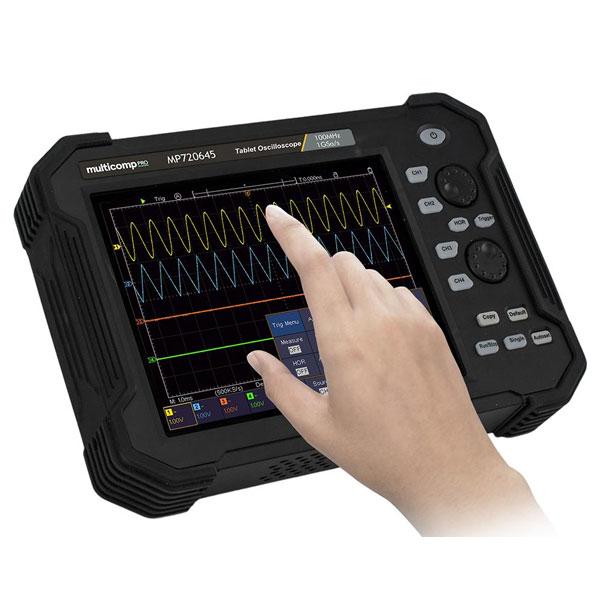
Are small voltage differences important? Then a higher vertical resolution can offer more value. The Multicomp Pro tablet oscilloscope with 100 MHz has four channels and a resolution of 14 bits.
Do you want to view all models? Then go to the full range of oscilloscopes .
The right probe head and safe measuring
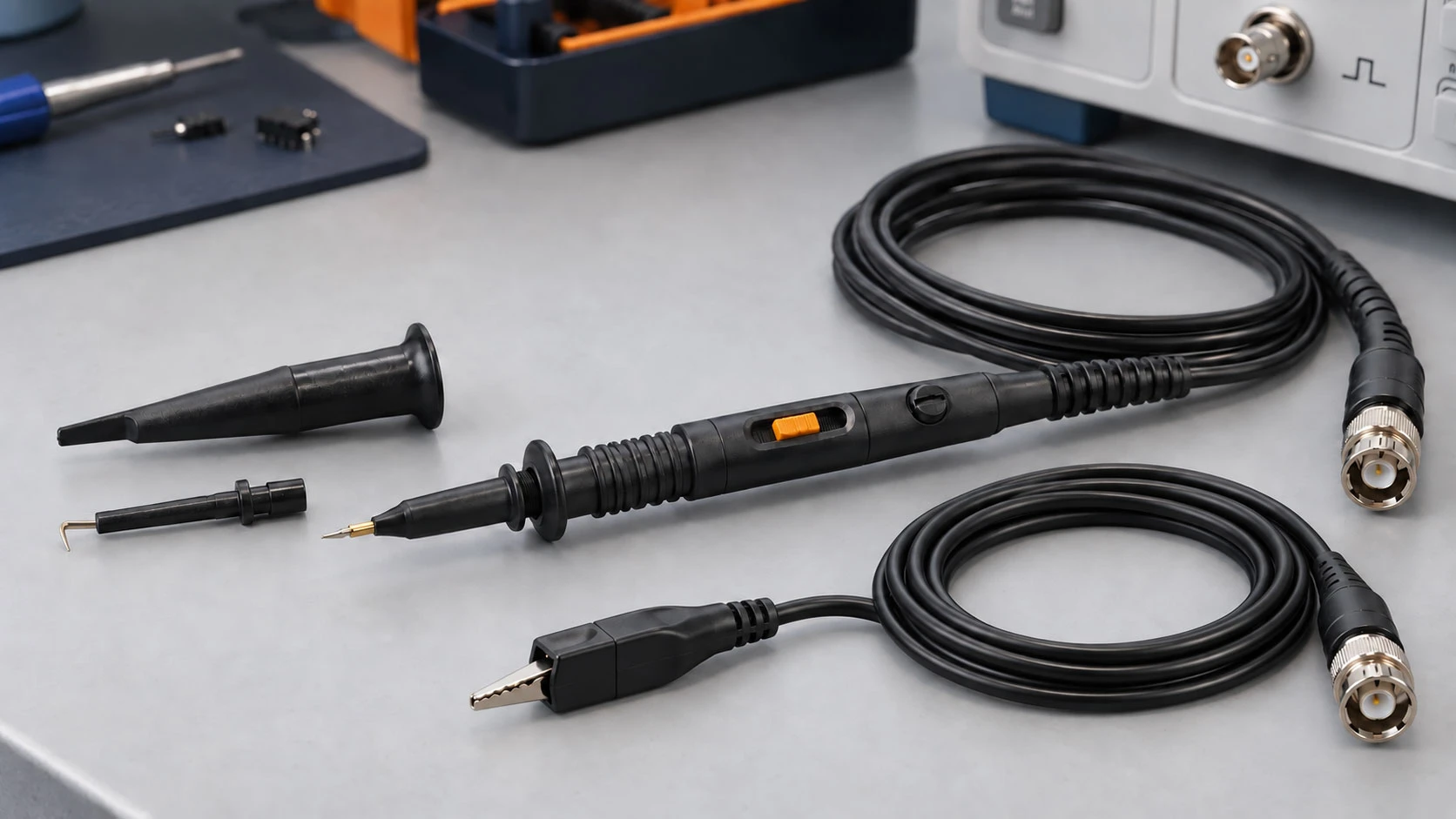
The probe head connects the oscilloscope to the circuit. Another name for the probe head is oscilloscope probe. The quality and setting of the probe head affect the measurement.
Many passive push heads have a 1× and 10× setting. In the 10× setting, the signal is attenuated ten times. The push head then usually loads the circuit less. A larger bandwidth is often available as well.
Always set the oscilloscope and probe to the same factor. Is the probe set to 10× and the oscilloscope to 1×? Then the screen will display an incorrect voltage.
A passive probe head must also be properly compensated. Many oscilloscopes have a special test output for this. This output usually provides a square wave. This allows you to check and adjust the probe head.
Keep the ground connection as short as possible with fast signals. A long ground wire can cause extra noise. It can also cause the waveform to show unwanted oscillations.
Safety is especially important at higher voltages. On many bench oscilloscopes, the ground clamp is connected to the protective earth. Therefore, you cannot connect the ground clamp to every measurement point.
An incorrect connection can cause a short circuit. The circuit and oscilloscope can also be damaged. Furthermore, immediate danger can arise at high voltages.
Never simply use a standard mains voltage probe head. A suitable differential probe head may be required for this. Also check the maximum voltage and safety class. Have hazardous measurements performed by someone with sufficient knowledge.
Which oscilloscope should you choose?
Don't start with the highest specifications. First, look at the signals you want to measure.
Answer these questions before purchasing:
- What types of signals do you want to look at?
- What is the highest expected frequency?
- How many signals do you want to measure simultaneously?
- Do you want to be able to make long recordings?
- Do you use the oscilloscope at a fixed workstation?
- Do you want to be able to take the instrument with you?
- Do you need a built-in signal generator?
- Are small voltage differences important?
For hobby use and education, a two-channel model is often sufficient. A bandwidth of 40 to 100 MHz is suitable for many general measurements.
Do you work with complex embedded projects? Then four channels offer more clarity. A sample rate of 1 GS/s and larger memory provide more headroom for longer and faster signals.
For fast digital electronics, 200 MHz or more may be required. Do not look only at the clock frequency. The speed of the signal edges also plays an important role.
Also consider the complete measurement solution. A good probe head is at least as important as the oscilloscope itself. Clear operation and appropriate safety classifications also matter.
View and compare the full range of oscilloscopes from Elektronica Voor Jou . Not sure which model suits your project? Then contact us. We are happy to help you make the right choice.
Frequently asked questions about oscilloscopes
What is the difference between an oscilloscope and a multimeter?
A multimeter usually displays a single measurement value. An oscilloscope shows how a voltage changes over time. As a result, you see pulses, noise, and brief disturbances.
How many MHz should an oscilloscope have?
For hobby use and general electronics, 40 to 100 MHz is often sufficient. Fast or complex digital electronics may require 200 MHz or more. Always choose slightly more bandwidth than the highest frequency you want to measure.
Which oscilloscope do I need for Arduino?
For many Arduino projects, a two-channel oscilloscope with 50 to 100 MHz is suitable. Four channels are useful if you want to view multiple signals simultaneously.
Do I need two or four channels?
With two channels, you can compare two signals. This is sufficient for many standard measurements. Four channels are suitable for more complex circuits and digital communication.
Can an oscilloscope measure current?
A standard oscilloscope measures voltage. Current can be measured with a current probe. You can also measure the voltage across a known resistor.
Can I measure mains voltage with an oscilloscope?
Do not simply use a standard probe head for this. The ground of a bench oscilloscope is often connected to the protective earth. Suitable measuring equipment and sufficient expertise are required for mains voltage.