

4.7 avg.
5487+ reviews View all
5487+ reviews
Order by 16:00 for same day shipping
14 days return
DE
EN
Individual
Business
Bambu Lab PC – Transparent – With Spool – 1KG
Description Bambu Lab PC – Transparent – With Spool – 1KG
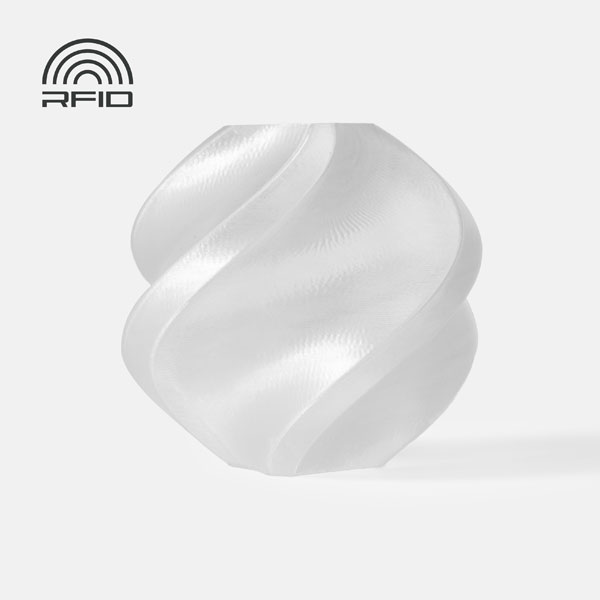
Bambu Lab PC (polycarbonate) is a strong and tough filament for functional parts. It is designed for prints that need to withstand impact and higher temperatures. Think of brackets, protective caps, mounting plates, and other technical components. This is a logical choice if PLA or PETG is just not strong enough.
PC is naturally a transparent thermoplastic. With Bambu PC Basic, the filament is furthermore designed for less shrinkage and better dimensional stability. As a result, the fit and dimensions remain more accurate, even with larger prints. Dry filament is important for a stable print. Store it airtight with desiccant and keep the humidity low.
This variant comes with a spool and contains 1 kg of filament with a diameter of 1.75 mm. The spool is made of PC + ABS and is heat-resistant up to 90 °C. Bambu recommends a nozzle temperature of 260–280 °C and a bed temperature of 90–110 °C. Use an Engineering Plate, High Temperature Plate, or Textured PEI Plate and use glue for good adhesion.
Bambu Lab PC – Transparent – With Spool – 1KG
In stock
€42.24
Order before 4:00 PM = shipped today
14 days free returns
5487+ reviews
4.7 avg.
5487+ reviewsView allSKU: BAMB2329 Categories: 3D Printer Filament , Bambu Lab , Bamby Lab Filament
Description Bambu Lab PC – Transparent – With Spool – 1KG
Bambu Lab PC (polycarbonate) is a strong and tough filament for functional parts. It is designed for prints that need to withstand impact and higher temperatures. Think of brackets, protective caps, mounting plates, and other technical components. This is a logical choice if PLA or PETG is just not strong enough.
PC is naturally a transparent thermoplastic. With Bambu PC Basic, the filament is furthermore designed for less shrinkage and better dimensional stability. As a result, the fit and dimensions remain more accurate, even with larger prints. Dry filament is important for a stable print. Store it airtight with desiccant and keep the humidity low.
This variant comes with a spool and contains 1 kg of filament with a diameter of 1.75 mm. The spool is made of PC + ABS and is heat-resistant up to 90 °C. Bambu recommends a nozzle temperature of 260–280 °C and a bed temperature of 90–110 °C. Use an Engineering Plate, High Temperature Plate, or Textured PEI Plate and use glue for good adhesion.